

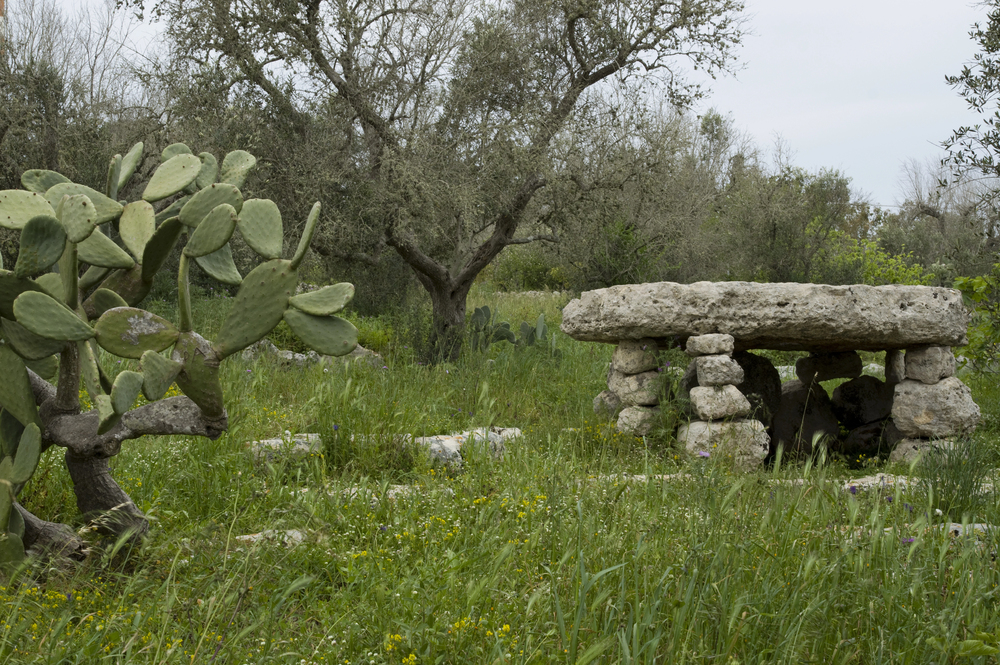
Minervino di Lecce isn’t the kind of place you can grasp right away. It’s a small village in the heart of Grecìa Salentina, with narrow streets and stone houses that ask nothing of passersby—and yet hold something back. We at Sinodia live and work here, and every time we take a group of young Europeans for a walk through the alleyways or up to the Li Scusi dolmen, we see the same expressions: first surprise, then something that looks like recognition.
Where is Minervino di Lecce located and why is it worth visiting?
Minervino di Lecce is located in the province of Lecce, in the lower Salento region, a few kilometers from the Adriatic coast and the historic centers of Otranto and Maglie. It is one of the municipalities that make up the Grecìa Salentina , that strip of towns where Griko, the Greek-Salento dialect, still survives today: a language that recounts two thousand years of cultural stratifications without the need for museums.
The village has no grand, postcard-worthy monuments. It has something different: a human scale that has become rare today. The squares are small, the churches are simple, and the streets aren’t designed for crowds. Those looking for the crowded Salento of August will probably have to look elsewhere. But those who want to understand how people used to live—and how they still live—in a town in southern Italy with ancient roots will find their answer here.
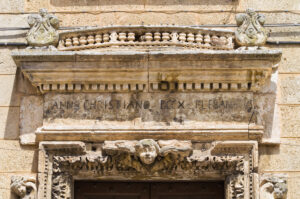
The historic center preserves traces of Lecce’s Baroque architecture, reinterpreted in the more austere styles typical of inland villages. The local stone—tuff and leccisu—define the colors and textures of every facade. There isn’t a single building to photograph and then move on from; rather, it’s an entire neighborhood to explore at a leisurely pace.
What is the Li Scusi dolmen, and what does it tell us about this area?
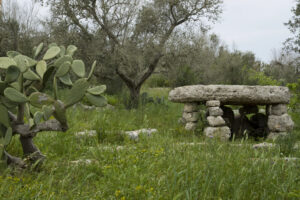
Not far from the town center, nestled amid Mediterranean scrub and centuries-old olive trees, lies the Li Scusi dolmen. It is one of the largest megalithic structures in Salento and among the most significant in all of Southern Italy: a prehistoric construction that predates any written history of this region by millennia.
A dolmen is, in its most basic form, a structure consisting of vertical stone slabs topped by a large horizontal slab. Li Scusi is impressive due to the size of its capstone, which is over four meters long. The precise function of these monuments—burial, ritual, or a landmark in the landscape—is still a subject of study, but their very presence speaks volumes: this area was inhabited and socially organized thousands of years ago, in a way that left permanent physical traces.
Taking a group of young people to the Li Scusi dolmen is not a tourist activity. It is a way to place the present within a broader historical perspective. Often, the young people who participate in our Erasmus+ projects arrive convinced that “real” history is found in the major European capitals. The Li Scusi dolmen tells a different story: that geographical periphery never coincides with the periphery of history.
Why is Minervino di Lecce the foundation of our European projects?
When a European organization seeks a partner in Salento, the first question is often practical: what does a small village offer that a city can’t? The answer, for us, is concrete. The intimate setting fosters concentration, sharing, and direct contact with the locals. A group of twenty young people in a city of one hundred thousand is invisible. In Minervino di Lecce, the same group is part of the town.
This has a specific educational value. Erasmus+ mobility programs—whether they are youth exchanges, training courses, or job-shadowing opportunities —work best when the host environment is not an anonymous institution but a place with its own identity. Minervino offers just that: a layered, discernible identity that is accessible to anyone who wants to understand it.
The surrounding landscape enhances the experience. The farmsteads, olive groves, scrubland, dolmens, and villages of Grecìa Salentina—all just a few minutes away—come together to create a backdrop that leaves a lasting impression and stays with you. It doesn’t replace the work done in the classroom or lab, but it grounds it in something tangible.
The skills developed through mobility aren’t limited to the professional sphere or interpersonal soft skills. They also include the ability to interpret a new context, find points of reference, and make sense of an unfamiliar place. These skills aren’t taught in the classroom; they’re honed through lived experience. And Minervino, with everything it has to offer, is an excellent place to develop them.
What do those who have been here, even for just a few days, take away?
Those who come to Minervino di Lecce for an Erasmus+ project rarely take away just the professional or educational experience they came for. They also take away images, conversations, and flavors. Bread baked in a wood-fired oven, the sunset light on the stone, the silence of the countryside just steps from the center: these are details that seem marginal, but instead remain.
Local traditions—rural cuisine, the olive-growing cycle, patron saint festivals, and Salento folk music—are not a show staged for visitors. They are part of the town’s everyday life. Taking part in this everyday life, even for just a few days, has an effect that’s hard to find in big cities: you get the feeling that you’ve truly been somewhere, not just passed through it.
In this sense, the Li Scusi dolmen serves as a metaphor for the entire region. It has stood there for thousands of years; it doesn’t demand attention, nor does it explain itself. But if you stop, if you get closer, if you try to understand it, it reveals a depth you didn’t expect. This is exactly how the heart of Salento works.
From here, we walk together: an invitation to talk about it
We are here, in Minervino di Lecce, and from this region we work every day on European projects, training, and cultural promotion. We don’t have an office in a capital city, and we’re not looking for one: we believe that the value of what we do lies precisely in being rooted in a specific place with a specific history.
If you’re considering an Erasmus+ experience and want to better understand how working with a local association works, if you’re a European organization or school looking for a reliable partner in Salento, or if you’re simply curious about what’s happening around here: the best thing you can do is write to us. We can’t promise immediate answers to everything, but we do promise an honest conversation.
You can do that on our “Contact Us” page. We’re a small town, but we’re used to doing big things from here.
Frequently Asked Questions
Is the Li Scusi dolmen accessible to everyone, even without a guide?
The dolmen is located in a natural area that can be reached on foot or by car without any particular physical difficulty. A guide isn’t required to visit it, but having someone who can provide context about the structure—both historically and in terms of the surrounding landscape—greatly enhances the experience. For specific information on accessibility, it’s best to contact the Municipality of Minervino di Lecce or the local tourist offices.
Is Minervino di Lecce a suitable location for a large group?
The town is small, and that is its educational strength—but it also means that lodging facilities have limited capacity. For large groups, it’s best to plan ahead and check local availability. However, its proximity to larger towns such as Maglie and Otranto makes it possible to spread the group out across the surrounding area.
What exactly do you do during an Erasmus+ project based in Minervino?
It depends on the type of project: a youth exchange has a different program than a training course or a VET mobility program. In all cases, the educational activities are intertwined with exploring the local area. Engaging with the local context—the people, traditions, and places—is an integral part of the experience, not just a side note.
Do you need to speak Italian to come here?
No. In Erasmus+ projects, the working language is often English, and participants do not necessarily need to know Italian to take part. The language barrier may seem like an obstacle, but it almost always turns out to be more manageable than expected—and becomes a learning opportunity in itself.
Can I visit Minervino di Lecce even outside the scope of a European project?
Of course. The village is open year-round, and the fall and winter seasons have a particularly authentic charm: fewer tourists, more contact with daily life. The Li Scusi dolmen, the Grecìa Salentina region, and the landscape of centuries-old olive trees are well worth a visit, regardless of any educational project.
How do I know if Sinodia is the right partner for my project?
The honest answer is: by talking to us. Every project has specific needs—based on industry, participants’ ages, and training objectives—and there’s no one-size-fits-all answer. Writing to us to describe your situation is the first step toward figuring out together if there’s a real match between what you’re looking for and what we do.